Exploiting Cybersecurity Buyer Intent Signals

Cybersecurity buyers often stay anonymous, avoiding giving out their contact details. This makes it tough for demand generation teams to hit lead and pipeline goals. But it also pushes teams to rethink strategies and tap into networks where buyers are active.
Your website as a cybersecurity vendor will never carry the same weight as a trusted news network or publisher with superstar journalists covering what matters most to the community. Buyers flock to these networks first because of the credibility and expertise behind those voices. That’s why it makes sense for you to position yourself nearby—not as a fly on the wall, but as something more intentional and refined. Imagine being a beautifully crafted listening post, like a finely designed sculpture with an oversized ear on a table—not intrusive, but always present, signaling that you’re attuned to the conversation and ready to respond when the moment is right.
By tracking buyer actions without being intrusive, go-to-market (GTM) teams can turn these signals—specific moves prospects make while researching—into precise, high-value wins.
Here are 10 key cybersecurity buyer intent signals with questions to engage prospects and drive revenue in 2025.
1. Whitepaper or eBook Downloads
Signal: Downloading a whitepaper or eBook shows a prospect is digging into a problem or solution.
Why it matters: Demand gen uses this to score leads; CMOs see what content works.
Example: A CISO grabbing a zero-trust guide hints at a tech shift, prompting sales outreach.
Questions:
-
What issues led you to our zero-trust guide?
-
Are you checking out vendors for a project?
-
How do whitepapers help your decisions?
2. Webinar Sign-Ups and Attendance
Signal: Signing up or attending webinars shows interest and trust, revealing roles and regions.
Why it matters: Marketers plan follow-up events; sales see a warm lead.
Example: More sign-ups for an “Identity Access Management” webinar trigger follow-up campaigns.
Questions:
-
What do you hope to learn from our webinar?
-
Are you facing specific IAM issues?
-
Want to talk with our experts after?
3. Repeated Product Page Visits
Signal: Visiting pricing or solution pages multiple times shows serious interest.
Why it matters: CMOs see faster pipelines; CROs spot strong leads.
Example: A Fortune 500 company hits the cloud security page three times, sparking outreach.
Questions:
-
What caught your eye about our cloud security?
-
Are you comparing vendor prices?
-
Can we set up a demo for your team?
With intent data you can battle-test your product marketing messaging and prioritize what gets the market buzzing! Learn why cybersecurity product leaders are demanding this intelligence in our quick start guide to cybersecurity intent data.
Read the Quick Start Guide Now!
4. Chatbot Interactions
Signal: Chatting with a bot turns anonymous visits into real leads.
Why it matters: Demand gen prioritizes these for follow-up; CMOs check digital performance.
Example: Compliance-focused bot chats shape local workshops.
Questions:
-
What compliance problems are you tackling?
-
How can we tailor a demo for you?
-
Which rules are driving your interest?
5. Repeated Email Opens and Clicks
Signal: Opening emails or clicking CTAs like “Book a Demo” shows ongoing interest.
Why it matters: CROs track deal speed; marketers test what works.
Example: IT directors clicking “Read the Report” spark targeted content.
Questions:
-
Which report topics match your goals?
-
Are you exploring a specific issue?
-
Want a walkthrough of our findings?
6. Cross-Channel Engagement
Signal: Engaging with ads, emails, and webinars shows strong interest.
Why it matters: CMOs confirm campaign success; CROs see deal readiness.
Example: A prospect hits ads, emails, and an event, cueing sales teamwork.
Questions:
-
How did you find our solutions?
-
Is your team evaluating us across channels?
-
Can we brief your buying group?
An omni-channel ABM strategy can build trust with a diverse buying group faster. Learn how this strategy can multiply your efforts in our quick start guide to cybersecurity intent data.
Read the Quick Start Guide Now!
7. Analyst Content Engagement
Signal: Reading Gartner or Forrester reports signals comparison and research.
Why it matters: CMOs measure trust; CROs prep sales with positioning.
Example: Security architects reading Gartner hint at vendor comparisons.
Questions:
-
How do analyst reports guide your choices?
-
What criteria are you using for vendors?
-
Want to discuss our Gartner fit?
8. Long Page Visits and Deep Scrolling
Signal: Spending time on pages or scrolling deep shows serious evaluation.
Why it matters: Demand gen scores these leads higher.
Example: CISOs lingering on briefings justify similar content.
Questions:
-
What in our briefing grabbed you?
-
Are you exploring a specific topic?
-
Need more resources for your review?
9. Multiple Team Members Engaging
Signal: Several team members engaging across channels suggest a group decision.
Why it matters: CROs focus on these accounts; marketers build custom campaigns.
Example: Three bank team members download compliance papers, signaling a project.
Questions:
-
How is your team handling its evaluation?
-
Which roles should we connect with?
-
Can we host a team workshop?
10. Search Intent Data
Signal: Keyword searches show early interest before visiting vendor sites.
Why it matters: Demand gen boosts awareness; CMOs track trends.
Example: A “phishing protection” search spike prompts CIO roundtables.
Questions:
-
What sparked your phishing protection searches?
-
Are you just starting to explore solutions?
-
Interested in a phishing trends roundtable?
Winning with Intent
Buyer intent signals can quickly show who’s ready, when, and how to connect. GTM teams using these signals swap random efforts for sharp, trust-building strategies.
Want to learn more about leveraging intent data for cybersecurity marketing? Click below to read our quick start guide immediately!
Read the Quick Start Guide Now!
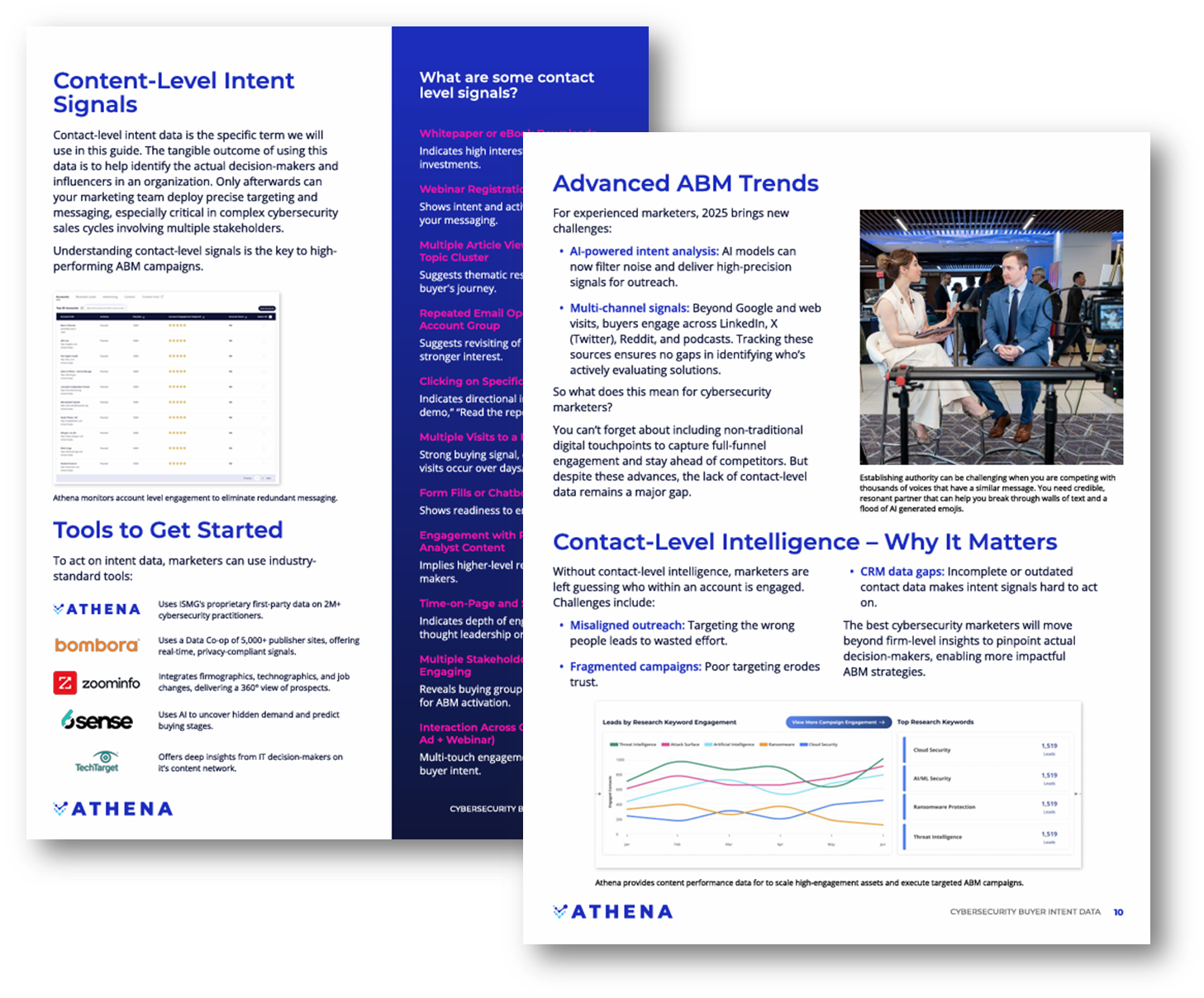
Introducing Athena by ISMG
At ISMG, we developed Athena to solve the toughest challenges cybersecurity marketers face with intent data. Unlike generic data providers, Athena is built on ISMG’s proprietary cybersecurity media network, which engages over 2 million practitioners globally and generates 15M+ monthly touchpoints.
Here’s how Athena transforms ABM for cybersecurity:
- Identifies named decision-makers actively researching cybersecurity topics.
- Delivers multi-touch engagement intelligence across articles, webinars, events, and peer discussions.
- Integrates directly into CRM and Salesforce, ensuring sales has real-time visibility into buyer activity.
- Provides white-glove activation support, ensuring campaigns are launched and optimized without operational bottlenecks.
Athena bridges the critical gap between account-level insights and true contact-level intelligence—empowering marketers to run ABM programs that not only resonate but convert.
The cybersecurity marketers who will win in 2025 are those who embrace intent-driven ABM powered by contact-level intelligence.
With AI filtering, multi-channel monitoring, and seamless sales alignment, marketing teams can finally cut through the noise and engage decision-makers at the right moment.
Athena by ISMG is purpose-built to provide this advantage. To see how Athena can optimize your cybersecurity marketing strategy, schedule a personalized demo today and take your ABM program to the next level.