Don’t Let a Salesperson Run Your Webinar

Most cybersecurity webinars fail before anyone even registers. It’s not the topic. It’s not the speaker. It’s the storyline—or lack of one. A webinar without a clear narrative arc is just a product demo with extra steps, and nobody registers for product demos anymore. There are too many tools out there that can get your product on a landing page as an interactive experience. If someone wants to see your platform in action, they don’t need to block off an hour of their calendar. This article shares some tips to build a memorable story that gets more registrations and holds your audiences attention.
Don't Cheat with Feature Lists Disguised as Education
Here’s a game you can play: go to any cybersecurity company’s events page and look at their upcoming webinars. You’ll find titles like “5 Ways Our Platform Stops Ransomware,” “The Future of Zero Trust (Featuring Our Product),” or “Why You Need [Our Solution] in 2026.” These don’t convert because they’re not stories. They’re feature lists with a countdown timer. The audience knows exactly what’s coming: 45 minutes of slides explaining how your product works, followed by 15 minutes of uncomfortable “any questions?” silence.
The problem isn’t that companies are trying to sell things. Of course they are. The problem is that they’re disguising a sales pitch as an educational event, and buyers have become very good at spotting the difference. They’ve sat through enough of these to know what “insights-driven” really means when it’s in a webinar title.
You Need a Problem, Some Tension, and a Resolution
The webinars that actually convert follow a simple three-act structure. It’s the same structure that makes good journalism, good documentaries, and good keynotes work—and there’s no reason your webinar should be any different.
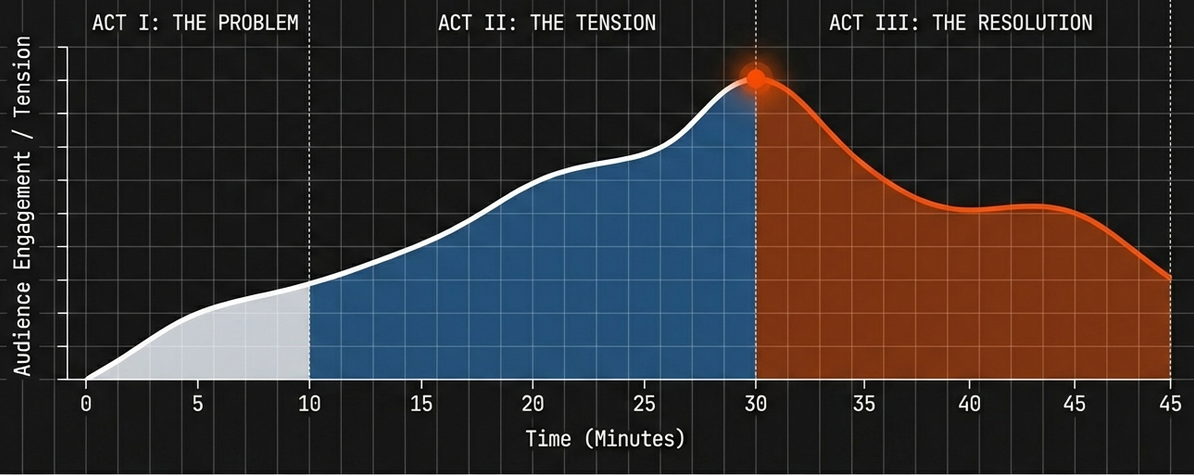
Act 1 is the Problem, and it should take up roughly the first ten minutes. This is where you establish what’s broken in the current approach, why existing solutions are failing, and what’s at stake if nothing changes. You’re not pitching here—you’re diagnosing. You want the audience nodding along, recognizing their own environment in what you’re describing.
Act 2 is the Tension, and this is where most webinars drop the ball. Give it twenty minutes. This is the part where you explain why the problem is genuinely hard to solve—what people have already tried, why it didn’t work, and what a smarter approach might look like. This is where you earn credibility. If you can articulate the audience’s failed attempts better than they can, they’ll trust you to offer something better.
Act 3 is the Resolution, and this is the only place your product should appear. Fifteen minutes is plenty. Here’s where you show how a specific approach actually solves the problem, back it up with proof—a customer story, a live demo, some hard data—and tell people what to do next. Notice that your product doesn’t show up until the very end, and even then, it’s positioned as evidence that the approach works, not the hero of the story.
A Ransomware Webinar, Done Two Ways
Here’s a concrete example of how this plays out. Take a common webinar topic: ransomware.
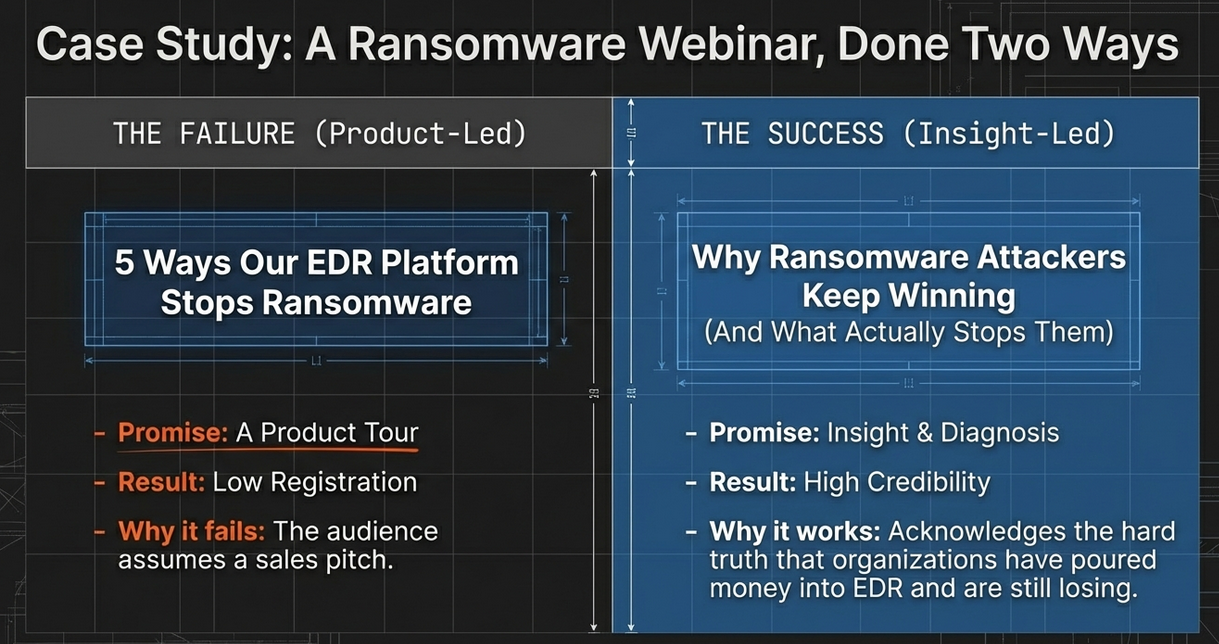
Bad storyline: “5 Ways Our EDR Platform Stops Ransomware.”
Good storyline: “Why Ransomware Attackers Keep Winning (And What Actually Stops Them).” Same topic. Completely different story.
The bad version promises a product tour. The good version promises to explain why everything else has failed—and what works instead. “Why Ransomware Attackers Keep Winning” starts with tension and market failure, not features. It acknowledges a hard truth that every security leader in your audience already feels: organizations have poured money into EDR, XDR, and MDR, and attackers are still winning. That framing signals insight rather than promotion. It promises diagnosis before prescription, and serious security leaders are far more interested in understanding what’s broken than in watching another tool demo.
Stop Trying to Be Everything at Once
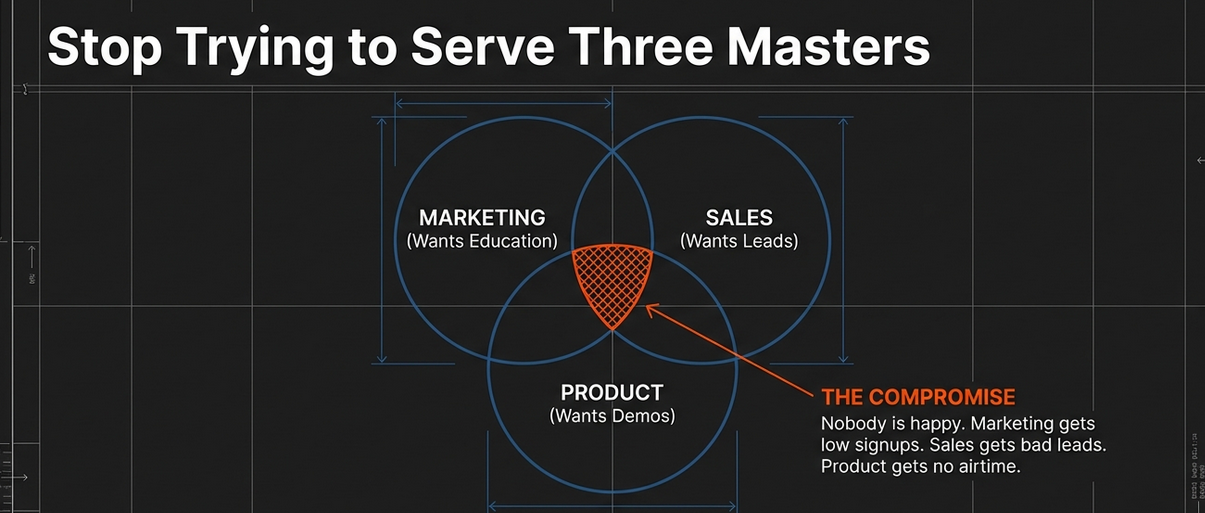
This is where most webinar programs quietly fall apart. Marketing wants educational content. Sales wants qualified leads. Product wants a demo slot. So you compromise—you build an “educational” webinar that’s secretly a demo, with a case study bolted on at the end to make it feel legitimate.
The result? Nobody’s happy. Marketing looks at the registration numbers and wonders why they can’t crack 100 signups. Sales follows up with the leads and finds nobody’s ready to buy. Product feels like the platform barely got any airtime. It’s the worst of all three outcomes, and it happens because the webinar was trying to serve three masters at once.
The fix is simple, even if it requires some internal negotiation: pick one storyline and commit to it. If it’s educational, make it genuinely educational—no demos, no “as you can see on this slide, our platform does X.” If it’s a demo, own that too. “Deep Dive: How [Company] Blocks Ransomware in Under 60 Seconds” is a great webinar title, because the people who register actually want to see the demo. But don’t try to be both. It never works.
Storylines I’ve Seen Work
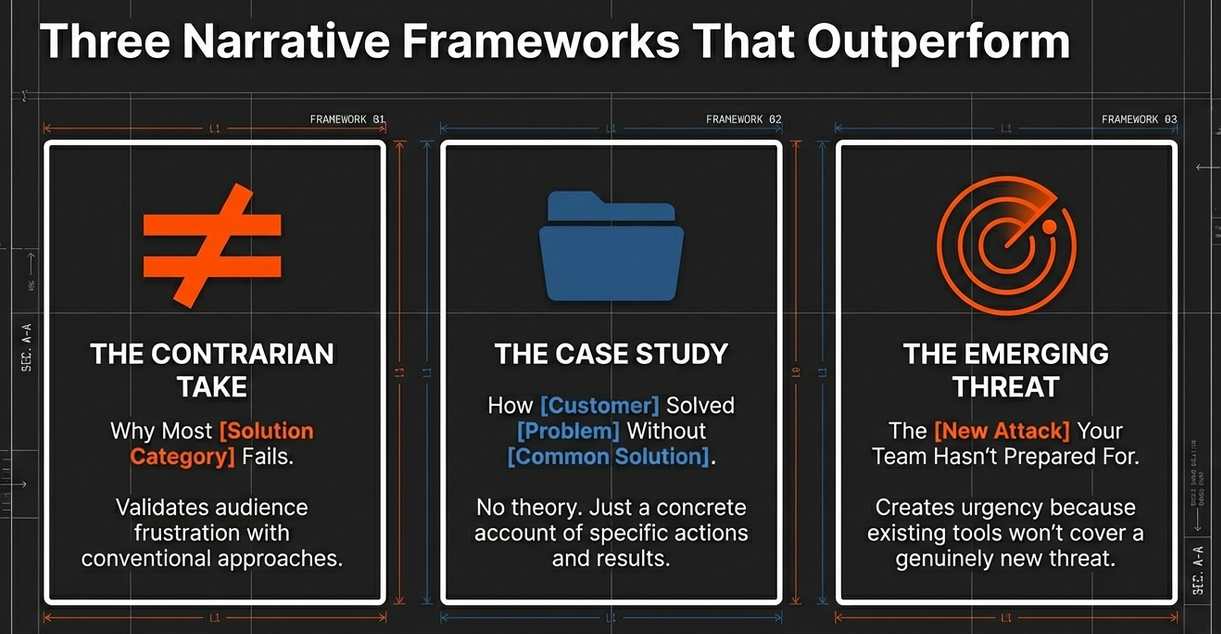
After sitting through and studying hundreds of these, a few narrative frameworks consistently outperform the rest:
- The Contrarian Take — “Why Most [Solution Category] Fails (And What Works Instead).” This works because it validates the audience’s frustration. They’ve tried the conventional approach. It didn’t work. Now they want to know why, and what actually does.
- The Case Study — “How [Customer] Solved [Problem] Without [Common Solution].” No theory, no best practices—just a concrete account of what one team did and what happened as a result. Specificity is what makes this credible.
- The Emerging Threat — “The [New Attack/Trend] Your Security Team Hasn’t Prepared For.” This creates urgency because if the threat is genuinely new, existing tools won’t cover it. The audience has a real reason to show up and learn something fast.
Cybersecurity Marketing is About Delivering Conversations
Ultimately, this is all a question of what you’re trying to do. A product-led webinar asks, “How do we explain what we built?” An insight-led webinar asks, “What misunderstanding in the market can we actually clarify?” The first might generate some short-term demo interest. The second builds credibility, trust, and long-term pipeline—because when buyers believe you understand the root of the problem better than anyone else does, they’re far more likely to believe you can solve it.
That’s the shift worth making. Don’t show up to sell. Show up to teach something true. The pipeline follows.