25 Webinar Promotion Tactics Every Cyber Marketer Needs to Steal

You’ve got a killer speaker, a topic your audience actually cares about, and a registration page that would make a conversion optimizer weep with joy. There’s just one problem: not enough people are signing up.
Cybersecurity is a crowded webinar market. Every vendor, analyst firm, and trade publication is fighting for the same CISO’s attention. Getting registrations isn’t about having the best topic — it’s about running a smarter promotion campaign than everyone else.
Here are 25 battle-tested tactics, organized across the five phases of a winning webinar promotion playbook. Pick the ones that fit your timeline and stack them — the more you layer, the better your numbers.
Pressed for time and want a high level overview of our webinar promotion playbook?
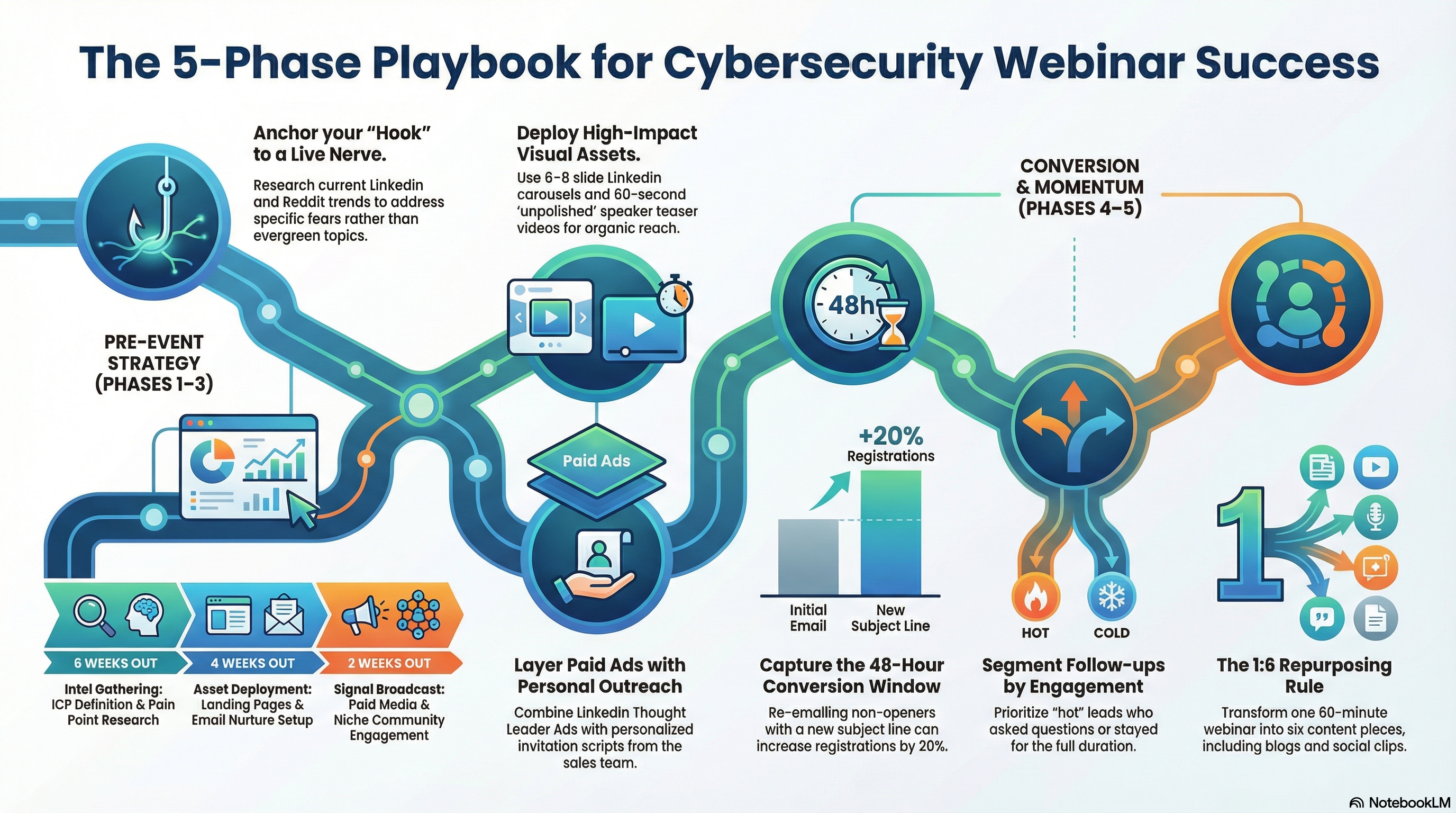
Intel Gathering (6 Weeks Out)
Before you write a single subject line, you need to know exactly who you’re talking to and what keeps them awake at night.
1. Define your ICP with surgical precision
Don’t just say “security professionals.” Are you targeting CISOs at mid-market financial services firms? SOC analysts at MSSPs? The tighter your ICP definition, the more every downstream decision — channel, copy, offer — snaps into focus. Document role, industry, company size, and security maturity level before you write a word.
2. Research the #1 pain point right now
Your topic might be evergreen, but your angle shouldn’t be. Check LinkedIn conversations, industry subreddits, Slack communities, and recent threat reports. What’s the specific fear or frustration your audience is expressing this month? Anchor your hook to a live nerve, not a theoretical one.
3. Audit your competitors’ recent webinars
Search for similar webinars on LinkedIn Events, Brighttalk, and ON24. What titles are they using? What angles are they hammering? Your job is to find the gap — the perspective nobody’s taken, the format nobody’s tried, or the audience segment nobody’s speaking to directly.
4. Build a threat-narrative hook
Cyber audiences respond to a specific emotional arc: fear (this threat is real and growing) → curiosity (here’s what you probably don’t know about it) → urgency (and here’s why you need to act now). Map your webinar topic to this arc before you write any promotional copy. It makes everything downstream easier.
5. Choose your conversion benchmark early
The industry benchmark for webinar show-up rates is around 40%. Set your registration goal based on how many live attendees you want, then work backwards. If you want 200 live attendees, target 500 registrants — and build your promo plan to hit that number.
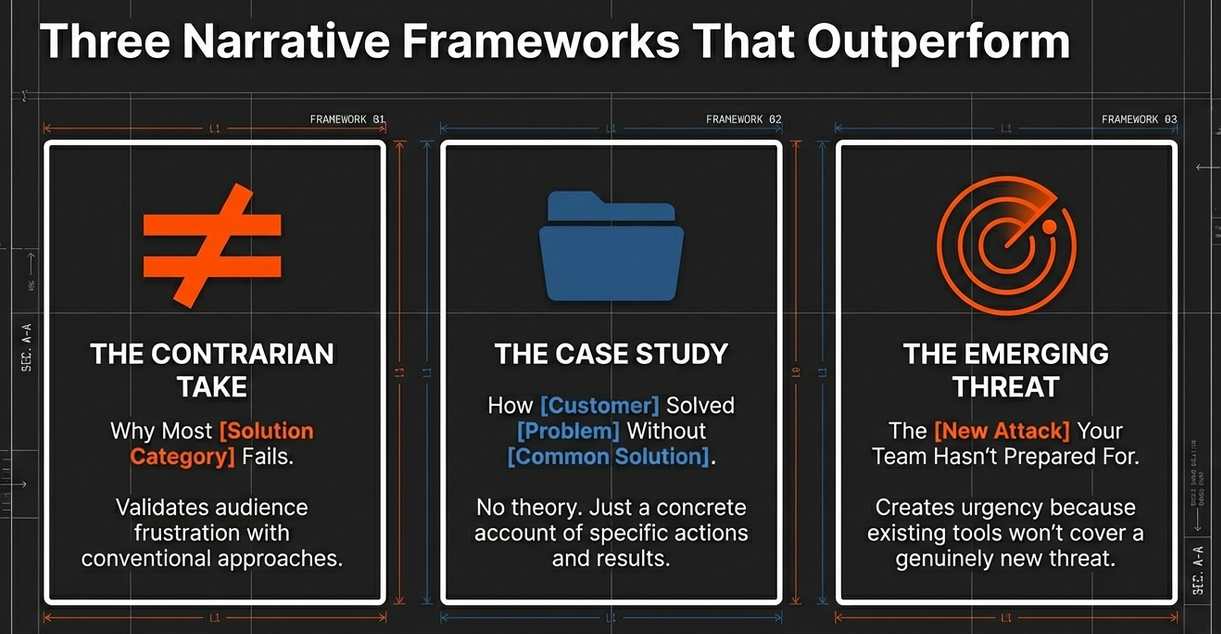
Learn more about webinar storylines we’ve seen work:
Asset Deployment (4 Weeks Out)
This is where most marketers start — which is why they’re always behind. By week four, your assets should be ready to launch, not still in review.
6. Write a landing page headline that earns the click
“Join Our Webinar: Q3 Threat Landscape Update” is not a headline. It’s a calendar entry. A real headline makes a specific promise to a specific person. Try: “Why 73% of Ransomware Victims Had EDR Deployed — And What They Missed.” Lead with the counterintuitive insight, the shocking stat, or the outcome your audience desperately wants.
7. Build a three-email nurture sequence
Email one is the announce — lead with the hook, make the case for why this matters right now, and include a clear CTA. Email two is the educate — share a teaser insight, a supporting stat, or a short excerpt from what attendees will learn. Email three is the urgency — seats are filling, the event is days away, here’s one more reason you can’t miss it.
8. Create a LinkedIn carousel post
Carousels consistently outperform static images in B2B LinkedIn feeds. Build a 6–8 slide carousel that unpacks one key insight from your webinar — enough to create genuine curiosity, not enough to give everything away. End with a registration CTA. Design for mobile: big text, bold visuals, zero clutter.
9. Produce a short teaser video
You don’t need a production crew. A 60–90 second smartphone video of your speaker delivering one punchy insight — shot in front of a branded background or even a clean wall — consistently outperforms polished graphics in organic reach. Keep it conversational, add captions, and end with the registration link in the caption.
10. Brief your speaker on their social duties
Your speaker’s network is your second biggest organic channel. Give them pre-written post drafts, a registration link with UTM tracking, and a clear ask: two posts per week in the lead-up. Make it as easy as possible. If they have to write copy from scratch, it won’t happen.
Signal Broadcast (2 Weeks Out)
Your assets are live. Now it’s time to distribute them across every channel at maximum volume.
11. Launch LinkedIn Sponsored Content
Target by job title, seniority, industry, and company size. Use Single Image Ads and Lead Gen Forms to reduce friction — attendees can register without leaving LinkedIn. Start with a $50/day test budget, monitor CTR and cost-per-registration daily, and kill what isn’t converting by day three.
12. Run LinkedIn Thought Leader Ads
This relatively new LinkedIn ad format lets you sponsor organic posts from individual employee accounts — including your speaker’s personal page. Thought Leader Ads typically achieve higher engagement than brand page Sponsored Content because they feel more native and credible. Combine with your speaker’s organic posts for compounding reach.
13. Activate retargeting pixels
Anyone who visited your landing page and didn’t register is a warm lead. Build a retargeting audience on LinkedIn (using the Insight Tag) and Google (via the Ads pixel) and serve them registration reminders. These audiences convert at significantly higher rates than cold traffic because they’ve already shown intent.
14. Post organic content three times per week
Vary the format: a teaser stat on Monday, a speaker quote graphic on Wednesday, a “3 things you’ll learn” post on Friday. Don’t repeat the same CTA every time — let some posts deliver value without a hard sell. Audiences tune out when every post screams “REGISTER NOW.”
15. Execute newsletter swaps with complementary partners
Identify two or three companies that serve your ICP but don’t compete with you directly — a threat intel firm if you’re a SIEM vendor, a GRC platform if you’re in identity security. Propose a newsletter swap: they promote your webinar to their list, you promote something of theirs. One partnership can add hundreds of high-quality registrants overnight.
16. Post in niche communities — carefully
Security Slack groups, ISAC communities, and industry Discords can be gold mines — but only if you contribute value first. Don’t drop a registration link on day one. Participate genuinely, then share your webinar as a resource, framing it around the community’s interests. A single post in a trusted community often outperforms thousands of dollars in paid ads.
17. Activate your sales team for personal outreach
Give your AEs and SDRs a short, conversational invitation script — not a marketing email, a personal note. “Hey [Name], we’re running a webinar on [topic] next week that I thought was directly relevant to what we talked about last month…” Sales-led invitations to warm prospects and target accounts consistently drive higher show-up rates than any marketing channel.
Countdown Protocol (1 Week Out)
The 48 hours before your webinar is the single highest-conversion window in your entire campaign. Don’t ease up — accelerate.
18. Re-email non-openers with a new subject line
If someone didn’t open your first announcement email, they didn’t see it — they didn’t reject it. Pull the non-opener segment and resend with a completely different subject line. Change the angle, not just the wording. An A/B test at this stage can add 15–20% more registrations from your existing list at zero additional cost.
19. Send an exclusive sneak-peek to existing registrants
This is one of the most underused tactics in webinar marketing. Send registrants a short email with one genuine insight from the webinar — a stat, a framework slide, a quote from the speaker. This creates anticipation, reinforces their decision to register, and dramatically increases the likelihood they actually show up. It also generates social sharing before the event.
20. Send a 24-hour and 1-hour reminder
Both. Always. The 24-hour reminder catches people who registered weeks ago and need to add it back to their calendar. The 1-hour reminder catches people who are at their desk and genuinely intend to join but will forget without a nudge. If you have SMS opt-ins, use them — text reminders have dramatically higher open rates than email.
21. Post a LinkedIn poll on the day of the event
Post a question related to your webinar topic — something provocative enough that people have an opinion. “What’s the #1 underestimated ransomware risk right now?” Polls generate comments and shares, which push your post into new feeds organically. End the caption with the registration link and the time of the event. It’s lightweight and it works.
Post-Event Recon (After the Webinar)
The webinar isn’t the finish line — it’s the starting gun for your follow-up pipeline. Most of the commercial value comes in the week after.
22. Send the on-demand replay within 2 hours
Every registrant who didn’t attend is a still-warm lead. Send them the replay link within two hours of the event ending — while the topic is still front of mind. Include a one-paragraph summary of the key takeaways to give no-shows a reason to click through even if they don’t have 60 minutes to watch the whole thing.
23. Segment your follow-up by engagement level
Not all attendees are equal. Someone who stayed for 55 minutes and asked two questions is very different from someone who dropped off after 8 minutes. Segment your follow-up accordingly: high-engagement attendees get a direct offer or sales follow-up; low-engagement attendees and no-shows get softer nurture content. Most webinar platforms can export this data automatically.
24. Repurpose aggressively and systematically
One 60-minute webinar should produce at least six pieces of downstream content: a long-form blog post (hello), three to four short LinkedIn clips from the recording, a quote graphic series, a podcast episode if you have one, a summary email to your full list, and a resource page on your website. Build a repurposing checklist and run it within 72 hours of every webinar.
25. Score leads and route hot signals to sales immediately
Use your marketing automation platform to assign engagement scores based on attendance duration, poll responses, Q&A participation, and post-event content clicks. Define a threshold score that constitutes a “hot” lead — and create an automated alert that notifies the relevant AE the moment someone crosses it. Speed-to-follow-up matters enormously; leads contacted within an hour of showing intent convert at dramatically higher rates than those contacted the next day.
Follow the Formula
None of these tactics is a silver bullet in isolation. The cyber marketers who consistently fill their webinars and fill their pipelines are the ones who run all five phases in sequence, stack multiple channels in each phase, and treat the post-event window as seriously as they treat the launch.
The formula is simple: a sharp hook that speaks to a real and current pain + multi-touch promotion across owned, earned, and paid channels + segmented follow-up that treats different engagement levels differently + systematic content repurposing = a webinar program that compounds in value over time.
Start with the phases you’re currently skipping. If you’re launching assets too late, move your start date back. If you’re not segmenting post-event follow-up, build the workflow this week. Small improvements across five phases add up faster than you’d think.
Now go fill that room.