Webinars shouldn’t be one-off events: High-performing teams design webinars as anchor moments in an integrated campaign, with high-intent PDFs planned in advance to extend impact, capture buyer intent, and fuel pipeline long after the live session ends.
Different PDF formats map to different buyer intent stages: Research snapshots, buyer’s guides, executive playbooks, assessments, and intelligence briefs each align to a distinct mindset—from self-evaluation and active buying to executive ownership and urgent response—making them especially powerful in content syndication.
Repurposing drives scale without burnout: Webinars capture live intent; PDFs scale that intent across time, channels, and senior audiences who value substance and control. Done right, repurposing builds steady demand momentum without exhausting teams or over-relying on top-of-funnel tactics
Cybersecurity Webinar to PDF Matchmaking

Key Takeaways
Webinar and PDF, Happy Together
We love webinars. But they need a soulmate. It’s called the PDF. When a webinar is intentionally repurposed into a focused, high-value PDF, it becomes a durable asset that extends reach, clarifies the core insights, and captures buyer intent in a more deliberate way. For senior audiences in particular, PDFs provide a practical format for reviewing, sharing, and acting on webinar content—making the original event more useful, measurable, and influential over time.
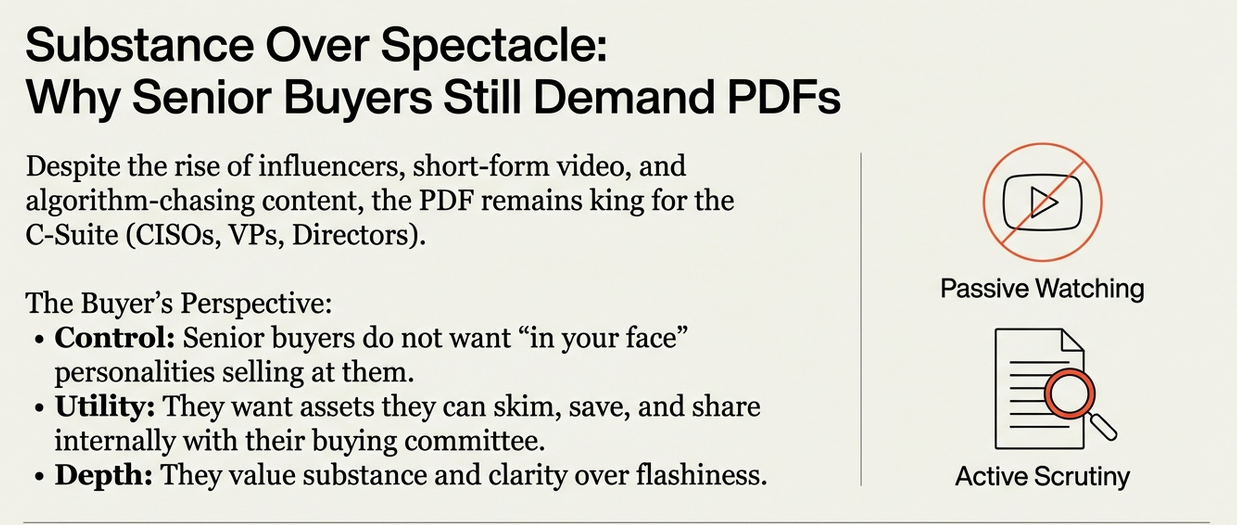
In this blog, I share five proven PDF formats beyond the traditional whitepaper, paired with the types of webinars that convert best into each.
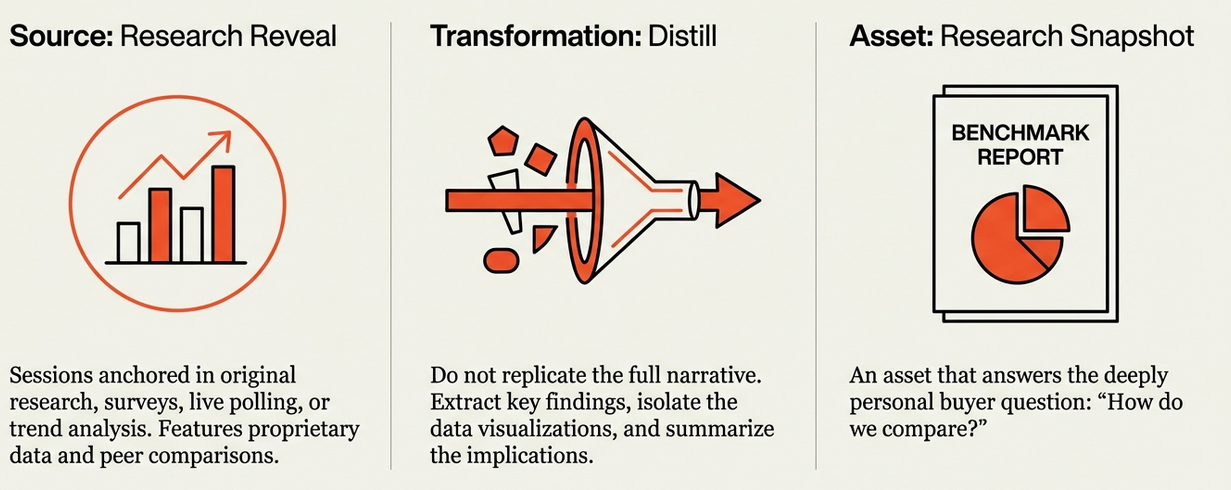
1. Annual Research Study
Best webinar type: Data-driven or research reveal
Webinars anchored in original research—surveys, benchmarks, or trend analysis—are natural feeders for research snapshot PDFs.
These webinars typically feature proprietary data, live polling, and peer comparisons. The PDF should distill the session into key findings, visuals, and implications, not replicate the full narrative.
For content syndication, benchmarks perform exceptionally well because they answer a deeply personal buyer question: How do we compare? That curiosity is a strong mid-to-late funnel signal.
Intent signal: “I’m evaluating my current state.”
When a buyer downloads a benchmark or research snapshot PDF, they’re asking where do we stand—and are we behind? The problem is already recognized, internal conversations are likely underway, and the buyer is pressure-testing their current approach against peers.
This is diagnostic intent—buyers gathering evidence to justify decisions, budget, or vendor shortlists.
- For marketing, the PDF should highlight gaps and implications, not just insights.
- For sales, it flags accounts ready for comparison-driven, consultative conversations grounded in data rather than product claims.
2. Buyer's Guide
Best webinar type: Panels or evaluation-focused sessions
Panel discussions on how to assess solutions, technologies, or approaches—especially those featuring practitioners or analysts—translate seamlessly into buyer’s guide PDFs.
The webinar conversation often surfaces real-world criteria, tradeoffs, and common mistakes. The PDF version formalizes those insights into decision frameworks, checklists, and comparison tables that buyers can reuse internally.
In syndication environments, buyer’s guides attract prospects who are already moving toward a purchase and need structure to support decision-making.
Intent signal: “I’m actively buying or preparing to.”
When a buyer engages with a buyer’s guide PDF, they’re no longer defining the problem—they’re evaluating options, criteria, and tradeoffs to support an imminent decision. We call this decision-stage intent.
Buyers desperately seek structure they can use internally to compare vendors, avoid mistakes, and justify a choice.
- For marketing, the PDF should emphasize clear frameworks and evaluation criteria.
- For sales, it flags accounts primed for direct, solution-oriented conversations focused on fit, differentiation, and next steps.
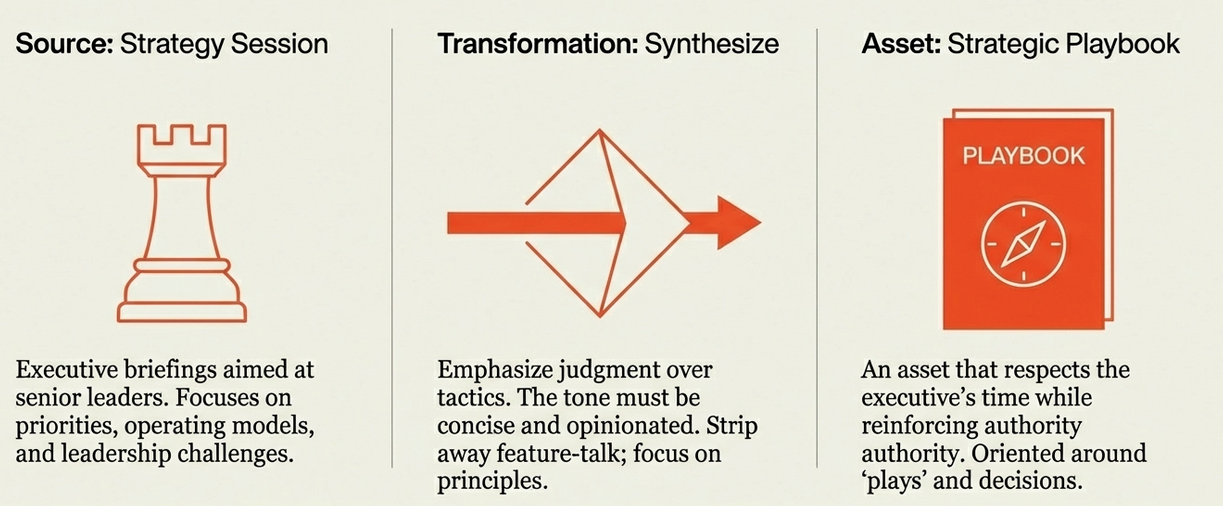
3. Executive Level Playbook
Best webinar type: Executive briefings or strategy-led discussions
Webinars aimed at senior leaders—focused on priorities, operating models, or leadership challenges—are ideal sources for executive playbooks.
These sessions emphasize judgment over tactics and direction over features. The resulting PDF should reflect that tone: concise, opinionated, and oriented around plays, principles, and decisions.
Executive playbooks perform well in syndication because they respect the audience’s time while reinforcing authority and credibility.
Intent signal: “I own this problem and need a plan.”
For cybersecurity marketing and sales teams, this intent signal reflects ownership and accountability, not evaluation.
When an executive engages with a playbook-style PDF they need to understand how to frame the problem, set priorities, and decide what to do next at an organizational level.
This is strategic intent at its core. The buyer is responsible for outcomes and needs a defensible plan, not feature detail.
- For marketing, the PDF should deliver clear principles, recommended plays, and decisive guidance.
- For sales, it signals an opportunity for executive-level conversations centered on roadmap alignment, risk tradeoffs, and long-term impact.
4. Assessment or Maturity Model
Best webinar type: Diagnostic or “where are you today?” webinars
Webinars that guide audiences through stages of capability—often using polls or scoring—convert naturally into self-assessment PDFs.
The PDF allows buyers to privately evaluate themselves against a maturity model, reinforcing the webinar’s insights without pressure. This format is especially effective in syndication because it turns passive consumption into active self-reflection.
It also creates a natural, non-intrusive follow-up path for sales and marketing teams.
Intent signal: “I know we’re not where we need to be.”
When a buyer engages with a self-assessment PDF, they’re recognizing deficiencies in their current capabilities and privately validating where they fall short.
This is gap-acknowledgment intent. Buyers are building internal awareness and readiness before committing to solutions.
- For marketing, the PDF should clearly surface maturity gaps and consequences.
- For sales, it creates a low-pressure entry point for diagnostic conversations focused on improvement paths rather than immediate pitches.
5. Intelligence Briefing
Best webinar type: Timely threat intelligence or incident-driven sessions
Webinars responding to emerging threats, regulatory changes, or real-world incidents are strong foundations for risk brief PDFs.
These assets should be focused, visual, and urgency-driven—highlighting what’s changed, who’s affected, and what leaders should do next. Compared to whitepapers, risk briefs feel more immediate and operational, which makes them highly effective for syndication.
Intent signal: “This is urgent and relevant right now.”
Buyers need fast clarity on impact, exposure, and next steps.
- For marketing, the PDF should emphasize what changed, who’s at risk, and immediate actions.
- For sales, it signals time-sensitive outreach opportunities focused on mitigation, readiness, and rapid response—not broad solution education.
Why This Approach Works
When webinars are designed as part of an integrated campaign—rather than standalone events—you gain leverage. One planning effort yields multiple high-value assets, each aligned to a specific buyer mindset. It’s important to remember that webinars capture live intent. PDFs scale that intent across channels, audiences, and time—especially with senior buyers who value substance over spectacle.
Content repurposing isn’t just efficient. It’s how modern demand programs build momentum without burning out teams or audiences.