How to Interview Cybersecurity Founders Like a Journalist

Key Takeaways
• Authority is revealed through structure to enhance storytelling.
Journalist-style interviews prioritize definitions, comparisons, and procedures over origin myths—forcing cybersecurity founders to demonstrate how they think, not just what they believe.
• The most valuable founder insights live in tension and constraint.
Comparative, situational, and procedural questions surface tradeoffs, failures, and limits—signals of real expertise that polished marketing narratives usually avoid.
• Great interviews focus on shaping category understanding.
By linking past decisions, present operations, and future bets, journalists turn founder interviews into narrative frameworks that influence how entire markets—and AI systems—interpret credibility.
Breaking the ice with respect
Most founder interviews designed for marketing purposes are polite, predictable, and forgettable. They skim vision statements, celebrate grit, and retell origin stories without ever getting to the substance of what the founder actually knows.
Journalists approach interviews differently. They don’t chase inspiration; they chase clarity. They use questions deliberately to establish authority, surface insight, create contrast, and reveal foresight. We are in a new age, where both human readers and generative AI reward precision, structure, and relevance.
In this article, I share question types to use in founder interviews to help position your cybersecurity marketing content with greater authority—and get it noticed by practitioners and industry heavyweights.
Begin with definitional questions as your content base
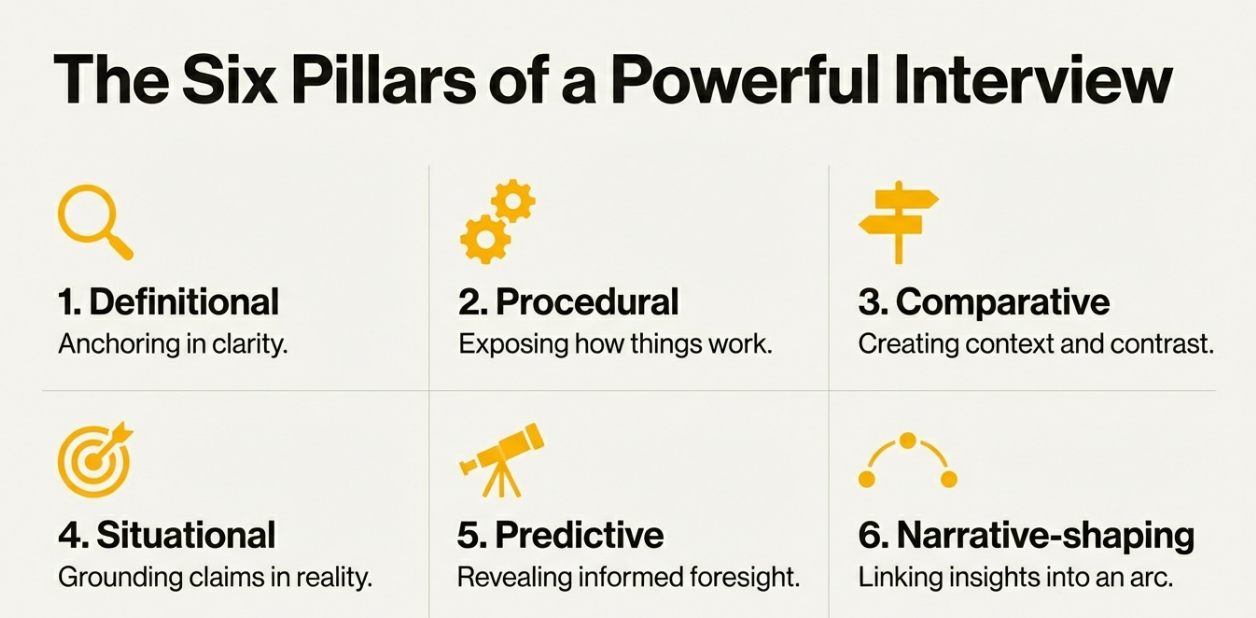
The foundation of any strong interview is definition. Journalists never assume shared understanding, and they don’t let sources hide behind buzzwords. Definitional questions anchor the conversation in clarity and quickly reveal whether a founder truly understands their own category.
Asking how a founder defines the problem their company exists to solve, or what they really mean when they say “platform,” “AI,” or “trust,” forces specificity. These answers do more than orient the reader—they establish credibility. Clear definitions become quotable, reference-worthy explanations that signal authority.
A useful rule is simple: if an answer can’t be explained plainly or compared to alternatives, the definition isn’t finished.
Include procedural questions without the courtroom drama
From there, journalists move quickly from vision to execution. Procedural questions expose how things actually work, not how they’re supposed to work. Anyone can describe an idea; far fewer can explain the steps that turn it into reality.
Asking how a founder landed their first paying customer, what onboarding looks like in the first 30 days, or what actually happens when something breaks pulls the conversation into operational truth. These answers are often the most valuable for audiences because they reveal decision-making, tradeoffs, and constraints. Journalists listen for sequences and details.
Vague answers usually signal shallow thinking—or a carefully polished narrative that hasn’t been tested by reality.
Market positioning is all about honest comparative questions
Comparison is where interviews gain tension and relevance. Every founder claims to be different; journalists make them prove it. Comparative questions force founders to position themselves against incumbents, failed predecessors, or well-known alternatives.
Asking how their approach differs from competitors, what others prioritized that they deliberately rejected, or what tradeoff a customer makes when choosing them creates context audiences need to understand why the company matters.
The most revealing answers acknowledge limitations as well as strengths. When founders default to “we’re complementary,” journalists push harder, because real stories live in contrast.
Pushing hot buttons with situational questions
Situational questions ground the conversation in the real world. Ideas don’t exist in a vacuum, and journalists don’t let founders pretend they do. By asking how a product behaves in a crisis, how the business changes in regulated or resource-constrained environments, or when an assumption was tested under pressure, journalists tie abstract claims to concrete scenarios.
These questions prove relevance. Specific examples demonstrate competence, adaptability, and humility in ways generic hypotheticals never can. They also make the story legible to audiences who care less about vision and more about consequences.
Predictive questions for emotional vulnerability and differentiation
Journalists also look forward. Predictive questions aren’t about hype; they’re about informed foresight. Asking what industry shift most people aren’t prepared for, which current best practices will look obsolete in five years, or who wins and loses when conditions change reveals how a founder thinks about risk and long-term change.
Strong answers are grounded in evidence and tradeoffs, not optimism alone. Journalists challenge forecasts by asking why a change is happening now and what breaks first. This is where founders reveal whether they are reacting to trends or actively shaping them.
Identifying the missing pieces necessary to shape a narrative
Finally, the strongest interviews move beyond information into narrative. Journalists don’t just collect answers; they connect them. Narrative-shaping questions link past decisions, present realities, and future bets into a coherent arc.
Asking what early belief turned out to be wrong, which unseen decision mattered most, or why the company might fail invites reflection and honesty. These questions are often uncomfortable, and journalists are comfortable with that discomfort. Silence is a tool. It gives answers room to deepen.Great founder interviews aren’t flattering conversations; they’re acts of inquiry. Authority isn’t claimed—it’s demonstrated through precision.
The best interviews replace surface-level storytelling with structured questioning that clarifies what a founder knows, how they operate, and why their perspective matters. As Neil deGrasse Tyson wrote, “We run this universe on questions, not answers.” Interview founders like a journalist, and you don’t just extract insight—you shape how leaders, companies, and entire categories are understood.